# Mastering Kubernetes Architecture: A Deep Dive for DevOps and Platform Engineers
*Understanding the intricate design and components that power the world's most popular container orchestration platform*
---
## Table of Contents
1. [Introduction: Beyond Container Orchestration](#introduction-beyond-container-orchestration)
2. [The Philosophical Foundation: Declarative Infrastructure](#the-philosophical-foundation-declarative-infrastructure)
3. [Architectural Overview: The Kubernetes Cluster Anatomy](#architectural-overview-the-kubernetes-cluster-anatomy)
4. [Deep Dive: Control Plane Components](#deep-dive-control-plane-components)
5. [Worker Node Components: Where Applications Live](#worker-node-components-where-applications-live)
6. [Advanced Architectural Patterns](#advanced-architectural-patterns)
7. [API Architecture: The Interface Layer](#api-architecture-the-interface-layer)
8. [Container Runtime Deep Dive](#container-runtime-deep-dive)
9. [High Availability and Scalability Patterns](#high-availability-and-scalability-patterns)
10. [Security Architecture](#security-architecture)
11. [Networking Architecture Deep Dive](#networking-architecture-deep-dive)
12. [Storage Architecture](#storage-architecture)
13. [Observability and Monitoring Architecture](#observability-and-monitoring-architecture)
14. [Extending Kubernetes: The Operator Pattern](#extending-kubernetes-the-operator-pattern)
15. [Future Architecture Considerations](#future-architecture-considerations)
16. [Best Practices for Platform Engineers](#best-practices-for-platform-engineers)
---
## Introduction: Beyond Container Orchestration
In the rapidly evolving landscape of cloud-native technologies, Kubernetes has emerged as the de facto standard for container orchestration. Yet, beneath its seemingly straightforward premise of "managing containers at scale" lies a sophisticated architectural masterpiece that embodies decades of distributed systems research and real-world operational wisdom.
As platform engineers and DevOps practitioners, understanding Kubernetes architecture isn't just about deploying applications—it's about comprehending the foundational principles that enable reliable, scalable, and maintainable distributed systems. This deep dive will explore the architectural decisions, design patterns, and implementation details that make Kubernetes the powerful platform it is today.
## The Philosophical Foundation: Declarative Infrastructure
Before diving into components, it's crucial to understand Kubernetes' fundamental philosophy. Unlike imperative systems where you specify *how* to achieve a state, Kubernetes operates on a **declarative model**. You define the desired state of your system, and Kubernetes continuously works to achieve and maintain that state.
This approach, known as **level-triggered infrastructure**, means Kubernetes constantly monitors the actual state against the desired state and takes corrective actions when they diverge. This design choice has profound implications for system reliability and operational simplicity.
```yaml
# You declare WHAT you want
apiVersion: apps/v1
kind: Deployment
metadata:
name: web-app
spec:
replicas: 3 # Desired state: 3 running instances
# Kubernetes figures out HOW to achieve this
```
## Architectural Overview: The Kubernetes Cluster Anatomy
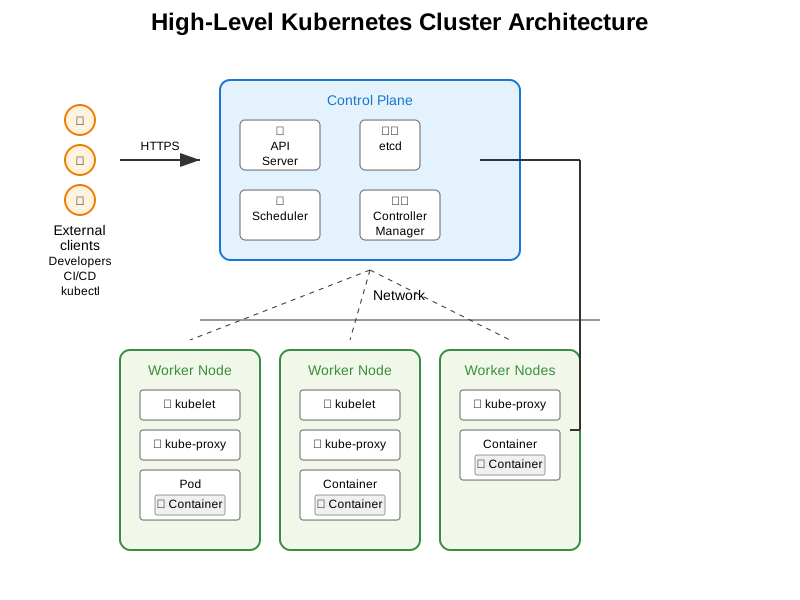
A Kubernetes cluster fundamentally consists of two types of nodes:
### Control Plane: The Brain of Operations
The control plane serves as the cluster's command center, making global decisions about the cluster and detecting and responding to cluster events. In production environments, the control plane typically runs across multiple nodes for high availability.
### Worker Nodes: The Execution Engine
Worker nodes host the actual application workloads. After Kubernetes installation, these nodes effectively become a unified compute fabric accessible through the Kubernetes API.
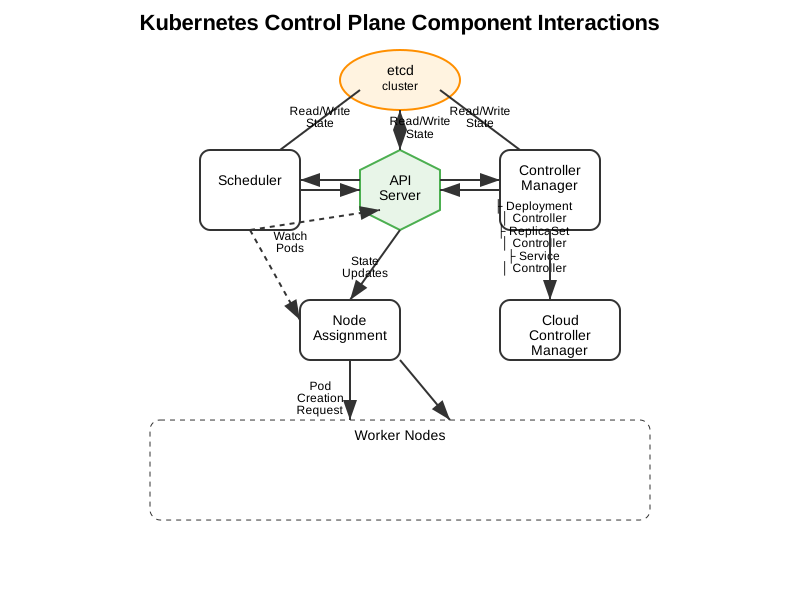
## Deep Dive: Control Plane Components
### The API Server: Gateway to Everything
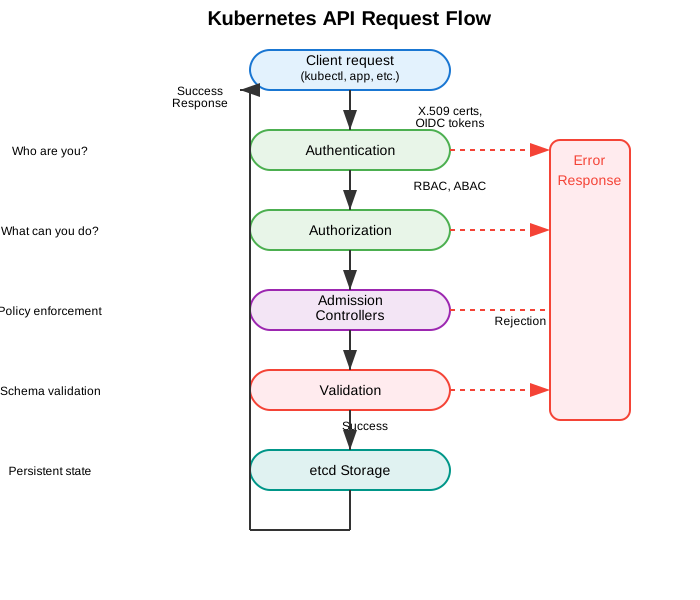
The **kube-apiserver** is arguably the most critical component in Kubernetes. It exposes the RESTful Kubernetes API and serves as the central hub through which all cluster communications flow.
**Key Characteristics:**
- **Stateless Design**: Can scale horizontally for high availability
- **Authentication & Authorization Hub**: Handles all security decisions
- **Validation Engine**: Ensures all API requests conform to schema and policies
- **Watch/Notify System**: Enables real-time cluster state monitoring
```go
// Example of API server interaction patterns
GET /api/v1/pods // List all pods
GET /api/v1/namespaces/production/pods?watch=true // Watch for changes
POST /api/v1/namespaces/production/pods // Create new pod
```
### etcd: The Source of Truth
**etcd** serves as Kubernetes' distributed data store, maintaining the entire cluster state. Understanding etcd's role is crucial for platform engineers:
**Architecture Implications:**
- **Consistency Model**: Uses Raft consensus algorithm for strong consistency
- **Performance Characteristics**: Optimized for reads, with write performance depending on cluster size
- **Backup Strategy**: Critical for disaster recovery planning
- **Network Requirements**: Requires low-latency connections between etcd nodes
```bash
# etcd stores all Kubernetes objects as key-value pairs
/registry/pods/default/my-app-12345
/registry/services/kube-system/kube-dns
/registry/configmaps/production/app-config
```
**Production Considerations:**
- Deploy etcd on dedicated nodes with SSD storage
- Use 3 or 5 node clusters for fault tolerance
- Implement regular backup strategies
- Monitor etcd performance metrics closely
### The Scheduler: Intelligent Workload Placement
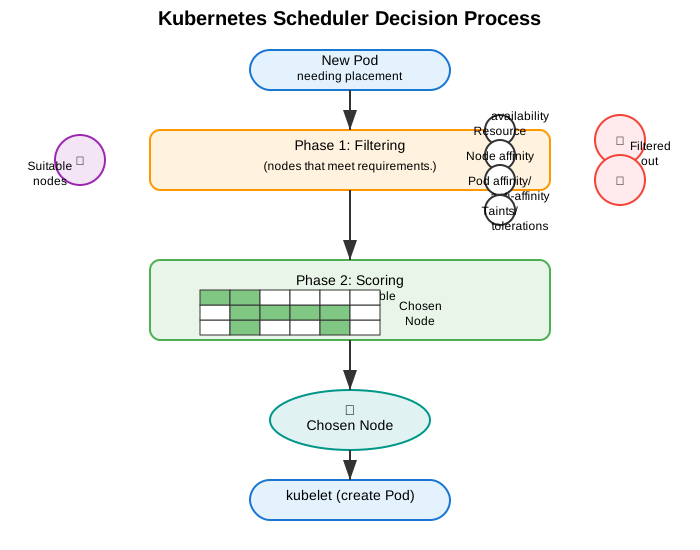
The **kube-scheduler** makes one of the most complex decisions in Kubernetes: where to place workloads. This component implements sophisticated algorithms considering multiple factors:
**Scheduling Factors:**
- **Resource Requirements**: CPU, memory, storage requests and limits
- **Hardware Constraints**: Node selectors, taints, and tolerations
- **Affinity Rules**: Pod-to-pod and pod-to-node affinity/anti-affinity
- **Policy Constraints**: Priority classes, resource quotas
- **Data Locality**: Considering storage and network proximity
```yaml
# Advanced scheduling example
apiVersion: v1
kind: Pod
spec:
affinity:
nodeAffinity:
requiredDuringSchedulingIgnoredDuringExecution:
nodeSelectorTerms:
- matchExpressions:
- key: kubernetes.io/arch
operator: In
values: ["amd64"]
podAntiAffinity:
preferredDuringSchedulingIgnoredDuringExecution:
- weight: 100
podAffinityTerm:
labelSelector:
matchExpressions:
- key: app
operator: In
values: ["web"]
topologyKey: failure-domain.beta.kubernetes.io/zone
```
### Controllers: The Reconciliation Engine
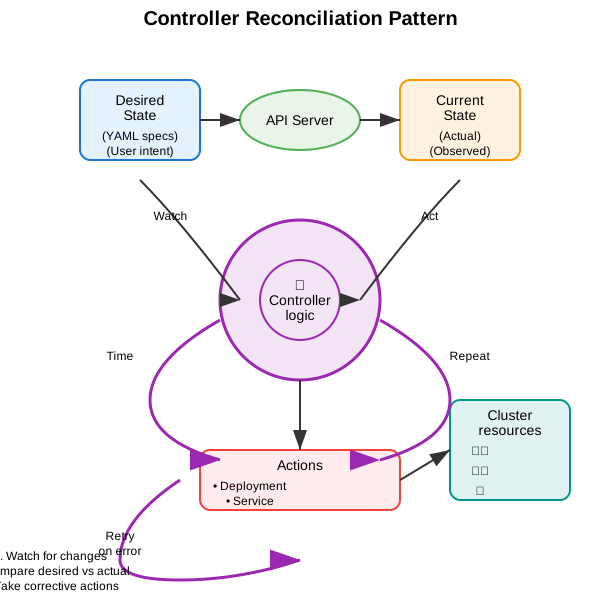
**Controllers** implement Kubernetes' declarative model through continuous reconciliation loops. Each controller watches specific resource types and works to align actual state with desired state.
**Key Controller Types:**
- **ReplicaSet Controller**: Maintains desired pod replicas
- **Deployment Controller**: Manages ReplicaSets for rolling updates
- **Service Controller**: Maintains service endpoints and load balancer state
- **Node Controller**: Monitors node health and manages node lifecycle
```go
// Simplified controller pattern
for {
desired := getDesiredState()
actual := getCurrentState()
if !reflect.DeepEqual(desired, actual) {
reconcile(desired, actual)
}
time.Sleep(reconciliationInterval)
}
```
## Worker Node Components: Where Applications Live
### kubelet: The Node Agent
The **kubelet** serves as Kubernetes' representative on each worker node, responsible for:
**Core Responsibilities:**
- **Pod Lifecycle Management**: Starting, stopping, and monitoring containers
- **Resource Reporting**: Communicating node capacity and usage to the API server
- **Health Monitoring**: Running liveness, readiness, and startup probes
- **Volume Management**: Mounting and unmounting storage volumes
### kube-proxy: Network Traffic Director
**kube-proxy** implements Kubernetes networking rules on each node, enabling service discovery and load balancing:
**Implementation Modes:**
- **iptables**: Default mode using iptables rules (scales to ~1000 services)
- **IPVS**: Higher performance mode for large clusters (10,000+ services)
- **userspace**: Legacy mode, rarely used in production
```bash
# Example iptables rules created by kube-proxy
-A KUBE-SERVICES -d 10.96.0.1/32 -p tcp -m tcp --dport 443 -j KUBE-SVC-API
-A KUBE-SVC-API -j KUBE-SEP-API-1 -m statistic --mode random --probability 0.5
-A KUBE-SVC-API -j KUBE-SEP-API-2
```
### Container Runtime: The Execution Layer
Modern Kubernetes supports multiple container runtimes through the **Container Runtime Interface (CRI)**:
**Runtime Options:**
- **containerd**: Default runtime, lightweight and efficient
- **CRI-O**: OCI-compliant runtime designed specifically for Kubernetes
- **Docker**: Legacy support through dockershim (removed in 1.24+)
## Advanced Architectural Patterns
### Distributed Systems Design Patterns in Kubernetes
Kubernetes enables several distributed systems patterns through its architecture:
#### Sidecar Pattern
Co-locate auxiliary containers with main application containers:
```yaml
apiVersion: v1
kind: Pod
spec:
containers:
- name: app
image: myapp:latest
- name: logging-sidecar
image: fluentd:latest
# Shares network and volumes with app container
```
#### Ambassador Pattern
Proxy external services through local containers:
```yaml
# Ambassador container provides local Redis interface
# while handling connection pooling, failover, etc.
- name: redis-ambassador
image: redis-ambassador:latest
ports:
- containerPort: 6379
```
#### Circuit Breaker and Retry Patterns
Implemented through service mesh integration or application-level logic.
### Multi-Tenancy and Isolation
Kubernetes provides several isolation mechanisms:
**Namespace-Level Isolation:**
```yaml
apiVersion: v1
kind: Namespace
metadata:
name: team-alpha
---
apiVersion: v1
kind: ResourceQuota
metadata:
namespace: team-alpha
spec:
hard:
requests.cpu: "10"
requests.memory: 20Gi
persistentvolumeclaims: "10"
```
**Network Policies for Traffic Segmentation:**
```yaml
apiVersion: networking.k8s.io/v1
kind: NetworkPolicy
metadata:
name: deny-all-ingress
spec:
podSelector: {}
policyTypes:
- Ingress
# Denies all ingress traffic by default
```
## API Architecture: The Interface Layer
### API Groups and Versioning
Kubernetes organizes its APIs into logical groups with independent versioning:
**Core API Groups:**
- **Core (v1)**: Pods, Services, ConfigMaps, Secrets
- **apps/v1**: Deployments, ReplicaSets, DaemonSets
- **networking.k8s.io/v1**: NetworkPolicies, Ingress
- **storage.k8s.io/v1**: StorageClasses, VolumeAttachments
### Resource Categories
Understanding resource categories helps with cluster organization:
```bash
# Workload resources
kubectl get deployments,replicasets,pods
# Discovery and load balancing
kubectl get services,ingress,endpoints
# Config and storage
kubectl get configmaps,secrets,persistentvolumeclaims
# Cluster administration
kubectl get nodes,namespaces,clusterroles
```
## Container Runtime Deep Dive
### The Container Runtime Interface (CRI)
The CRI represents a crucial architectural decision that enables runtime pluggability:
**CRI Services:**
```protobuf
service RuntimeService {
rpc Version(VersionRequest) returns (VersionResponse);
rpc RunPodSandbox(RunPodSandboxRequest) returns (RunPodSandboxResponse);
rpc StopPodSandbox(StopPodSandboxRequest) returns (StopPodSandboxResponse);
rpc CreateContainer(CreateContainerRequest) returns (CreateContainerResponse);
rpc StartContainer(StartContainerRequest) returns (StartContainerResponse);
// ... additional methods
}
service ImageService {
rpc ListImages(ListImagesRequest) returns (ListImagesResponse);
rpc ImageStatus(ImageStatusRequest) returns (ImageStatusResponse);
rpc PullImage(PullImageRequest) returns (PullImageResponse);
// ... additional methods
}
```
### Runtime Selection Considerations
**Performance Characteristics:**
- **containerd**: Lower resource overhead, faster pod startup
- **CRI-O**: Minimal attack surface, OCI compliance focus
- **Kata Containers**: VM-level isolation for security-critical workloads
**Security Implications:**
- Traditional runtimes share kernel with host
- Lightweight VMs (Kata, gVisor, Firecracker) provide stronger isolation
- Consider threat model when choosing runtime
## High Availability and Scalability Patterns
### Control Plane HA Architecture
```yaml
# Example HA configuration considerations
etcd:
nodes: 3 # Always use odd numbers (3, 5, 7)
placement: separate-availability-zones
api-server:
replicas: 3
load-balancer: external # HAProxy, cloud LB, etc.
scheduler:
replicas: 3
leader-election: enabled # Only one active instance
controller-manager:
replicas: 3
leader-election: enabled
```
### Scaling Considerations
**Cluster Scaling Limits:**
- **Nodes**: 5,000 nodes per cluster
- **Pods**: 150,000 total pods
- **Containers**: 300,000 total containers
- **Services**: 10,000 services per cluster
**Performance Optimization:**
```yaml
# API server tuning
--max-requests-inflight=400
--max-mutating-requests-inflight=200
--watch-cache-sizes=persistentvolumeclaims#100,nodes#1000
# etcd tuning
--quota-backend-bytes=8589934592 # 8GB
--heartbeat-interval=250
--election-timeout=1250
```
## Security Architecture
### Defense in Depth
Kubernetes implements multiple security layers:
**Authentication Methods:**
- **X.509 Client Certificates**: For kubelet and admin access
- **Service Account Tokens**: For in-cluster authentication
- **OIDC Tokens**: For integration with identity providers
- **Webhook Token Authentication**: For custom auth systems
**Authorization Models:**
```yaml
# RBAC example
apiVersion: rbac.authorization.k8s.io/v1
kind: ClusterRole
metadata:
name: pod-reader
rules:
- apiGroups: [""]
resources: ["pods"]
verbs: ["get", "watch", "list"]
---
apiVersion: rbac.authorization.k8s.io/v1
kind: ClusterRoleBinding
metadata:
name: read-pods
subjects:
- kind: User
name: jane
apiGroup: rbac.authorization.k8s.io
roleRef:
kind: ClusterRole
name: pod-reader
apiGroup: rbac.authorization.k8s.io
```
### Admission Controllers
Admission controllers provide the final validation and mutation layer:
**Built-in Controllers:**
- **NamespaceLifecycle**: Prevents deletion of system namespaces
- **ResourceQuota**: Enforces resource limits
- **PodSecurityPolicy**: Enforces security policies (deprecated)
- **SecurityContextConstraints**: OpenShift's security enforcement
**Custom Admission Controllers:**
```yaml
apiVersion: admissionregistration.k8s.io/v1
kind: ValidatingAdmissionWebhook
metadata:
name: pod-policy-webhook
webhooks:
- name: pod-policy.example.com
clientConfig:
service:
name: pod-policy-webhook
namespace: default
path: "/validate"
rules:
- operations: ["CREATE"]
apiGroups: [""]
apiVersions: ["v1"]
resources: ["pods"]
```
## Networking Architecture Deep Dive
### The Container Network Interface (CNI)
Kubernetes delegates networking to CNI plugins, enabling flexible network architectures:
**CNI Plugin Categories:**
- **Overlay Networks**: Flannel, Weave, Calico (IPIP mode)
- **Routed Networks**: Calico (BGP mode), Cilium
- **Cloud Provider Integration**: AWS VPC CNI, Azure CNI, GCP CNI
**Network Policy Implementation:**
```yaml
apiVersion: networking.k8s.io/v1
kind: NetworkPolicy
metadata:
name: web-netpol
spec:
podSelector:
matchLabels:
app: web
policyTypes:
- Ingress
- Egress
ingress:
- from:
- podSelector:
matchLabels:
app: frontend
ports:
- protocol: TCP
port: 8080
```
## Storage Architecture
### Persistent Volume Subsystem
Kubernetes abstracts storage through a sophisticated subsystem:
**Storage Classes and Dynamic Provisioning:**
```yaml
apiVersion: storage.k8s.io/v1
kind: StorageClass
metadata:
name: fast-ssd
provisioner: kubernetes.io/aws-ebs
parameters:
type: gp3
iops: "3000"
throughput: "125"
allowVolumeExpansion: true
reclaimPolicy: Retain
volumeBindingMode: WaitForFirstConsumer
```
**Container Storage Interface (CSI):**
```yaml
apiVersion: v1
kind: Pod
spec:
containers:
- name: csi-driver
image: csi-driver:latest
volumeMounts:
- name: socket-dir
mountPath: /csi
volumes:
- name: socket-dir
hostPath:
path: /var/lib/kubelet/plugins/csi-driver
type: DirectoryOrCreate
```
## Observability and Monitoring Architecture
### Built-in Observability
Kubernetes provides extensive observability through multiple channels:
**Metrics Architecture:**
- **cAdvisor**: Container metrics collection
- **kubelet**: Node and pod metrics
- **kube-state-metrics**: Kubernetes object state metrics
- **Metrics Server**: Resource utilization APIs
```yaml
# HorizontalPodAutoscaler using custom metrics
apiVersion: autoscaling/v2
kind: HorizontalPodAutoscaler
metadata:
name: web-hpa
spec:
scaleTargetRef:
apiVersion: apps/v1
kind: Deployment
name: web-app
minReplicas: 2
maxReplicas: 10
metrics:
- type: Resource
resource:
name: cpu
target:
type: Utilization
averageUtilization: 70
- type: Pods
pods:
metric:
name: http_requests_per_second
target:
type: AverageValue
averageValue: "1k"
```
## Extending Kubernetes: The Operator Pattern
### Custom Resources and Controllers
The Operator pattern extends Kubernetes with domain-specific knowledge:
```yaml
apiVersion: apiextensions.k8s.io/v1
kind: CustomResourceDefinition
metadata:
name: databases.example.com
spec:
group: example.com
versions:
- name: v1
served: true
storage: true
schema:
openAPIV3Schema:
type: object
properties:
spec:
type: object
properties:
size:
type: string
enum: ["small", "medium", "large"]
backup:
type: boolean
status:
type: object
properties:
phase:
type: string
endpoint:
type: string
scope: Namespaced
names:
plural: databases
singular: database
kind: Database
```
## Future Architecture Considerations
### Emerging Patterns and Technologies
**WebAssembly (WASM) Runtime Integration:**
```yaml
apiVersion: v1
kind: Pod
spec:
runtimeClassName: wasmtime
containers:
- name: wasm-app
image: myapp.wasm
```
**Edge Computing Adaptations:**
- **K3s**: Lightweight Kubernetes for edge devices
- **MicroK8s**: Minimal Kubernetes for development and edge
- **Virtual Kubelet**: Connecting external compute providers
**Service Mesh Integration:**
The future of Kubernetes likely includes deeper service mesh integration:
```yaml
apiVersion: networking.istio.io/v1beta1
kind: VirtualService
metadata:
name: reviews
spec:
hosts:
- reviews
http:
- match:
- headers:
end-user:
exact: jason
route:
- destination:
host: reviews
subset: v2
- route:
- destination:
host: reviews
subset: v1
```
## Best Practices for Platform Engineers
### Cluster Design Principles
1. **Separation of Concerns**: Separate compute, storage, and network planes
2. **Immutable Infrastructure**: Treat clusters as cattle, not pets
3. **Resource Planning**: Size clusters based on workload characteristics
4. **Security by Default**: Implement least-privilege access patterns
### Operational Excellence
```bash
# Cluster health monitoring
kubectl get componentstatuses
kubectl top nodes
kubectl get events --sort-by=.metadata.creationTimestamp
# Performance monitoring
kubectl get --raw /metrics | grep apiserver_request_duration
kubectl get --raw /api/v1/nodes/{node-name}/proxy/stats/summary
```
### Cost Optimization Strategies
**Resource Right-Sizing:**
```yaml
resources:
requests:
cpu: 100m # Actual usage requirement
memory: 128Mi
limits:
cpu: 500m # Burst capability
memory: 256Mi # Hard limit
```
**Cluster Autoscaling Configuration:**
```yaml
apiVersion: v1
kind: ConfigMap
metadata:
name: cluster-autoscaler-status
namespace: kube-system
data:
scale-down-delay-after-add: "10m"
scale-down-unneeded-time: "10m"
scale-down-utilization-threshold: "0.5"
skip-nodes-with-local-storage: "false"
```
## Conclusion: The Evolution Continues
Kubernetes architecture represents a remarkable achievement in distributed systems design, embodying principles of resilience, scalability, and extensibility. As platform engineers, our role extends beyond simply deploying applications—we're architects of the platforms that enable organizational agility and innovation.
The architectural patterns we've explored—from the declarative API model to the pluggable runtime interface—demonstrate how thoughtful design decisions enable a system to evolve and adapt to changing requirements. As Kubernetes continues to mature, new patterns and practices will emerge, but the fundamental architectural principles will remain constant.
**Key Takeaways for Platform Engineers:**
1. **Understand the Trade-offs**: Every architectural decision in Kubernetes involves trade-offs between simplicity, performance, and flexibility
2. **Embrace the Declarative Model**: Design your platforms and processes around desired state management
3. **Plan for Scale**: Consider not just current requirements, but future growth patterns
4. **Security is Architectural**: Build security considerations into your platform design from the beginning
5. **Observability is Essential**: Design comprehensive monitoring and logging strategies
As we look toward the future, Kubernetes will continue to evolve, incorporating new technologies like WebAssembly, edge computing capabilities, and deeper AI/ML integration. The architectural principles we've explored will serve as the foundation for these innovations, ensuring that Kubernetes remains the backbone of cloud-native computing for years to come.
---
*Continue your Kubernetes journey by exploring advanced topics like custom operators, multi-cluster management, and specialized workload patterns. The architecture we've examined today provides the foundation for understanding these more complex scenarios and designing robust, scalable platforms for the future.*
**Tags:** #Kubernetes #DevOps #PlatformEngineering #CloudNative #ContainerOrchestration #DistributedSystems #Architecture #Infrastructure
---
**About the Author:** Platform engineering expertise focusing on Kubernetes architecture, distributed systems design, and cloud-native infrastructure patterns.
## Visual Architecture Diagrams
For better understanding of the concepts covered in this guide, refer to the following architectural diagrams:
- [High-Level Cluster Architecture](./images/k8s-high-level-architecture.svg)
- [Control Plane Components](./images/control-plane-components.svg)
- [API Request Flow](./images/api-request-flow.svg)
- [Scheduler Process](./images/scheduler-process.svg)
- [Controller Reconciliation](./images/controller-reconciliation.svg)
## Practical Examples
For hands-on implementation of these architectural concepts:
- [RBAC Security Examples](./examples/rbac-examples.yaml)
- [Multi-Container Patterns](./examples/multi-container-patterns.yaml)
- [Network Policy Examples](./examples/network-policy-examples.yaml)
- [Monitoring Configuration](./examples/monitoring-config.yaml)
- [Quick Reference Guide](./kubernetes-quick-reference.md)